Showing posts with label Review. Show all posts

Samsung Galaxy S II Review,Specs

4.3" SUPER AMOLED Plus
The 4.3" SUPER AMOLED Plus display goes a step beyond the already remarkable SUPER AMOLED to provide enhanced readability, a slimmer design, and better battery consumption for the best viewing value of any smartphone.

Dual Core Application Processor
Clocking at lightening speeds the unrivaled performance of the Dual Core Application Processor provides unsurpassed functionality and density for faster browsing, quicker multi-tasking, a smoother UI, snappier streaming and highly efficient gaming. With encoding/decoding ability that supports video play and recording, makes it no.1 among dual cores.

8.49mm Slim Design
Taking slim to the next dimension. The Samsung GALAXY S II rides the leading edge with an ultra-slim 8.49mm form factor, a luxurious design and an easy grip. The ultra-slim smartphonealso boasts 3D TouchWiz UX adds to the evolutionary experience with a futuristic user interface.

8MP Camera with LED Flash
Get your shots in. The 8MP auto focus camera doesn’t miss any details whether you’re shooting idleness or action. Take beautiful, detailed photos even in low light with the built-in LED flash. And thanks to the much improved user interface of Android Gingerbread, fast scene switching is possible. And a quick switch to the 2MP front-facing camera makes self-portraits a snap.

Full HD Recording & Playback
Be a star. Let the Samsung GALAXY S II’s video shooting capabilities bring out the celebrity in you. Featuring 1080p Full HD Recording, every moment is a potential masterpiece in the making. Capture the action in high resolution and in dual core speed, instantly play back your HD footage in incredible clarity on the 4.3” SUPER AMOLED Plus display.

Network
HSPA+ 21Mbps/ HSUPA 5.76Mbps
EDGE/ GPRS Class 12
Quad band GSM 850/900/1800/1900
Quad band UMTS 850/900/1900/2100
AP
Dual Core Application Processor
Dimensions
125.3X66.1X8.49mm
Display
4.3" WVGA SUPER AMOLED Plus *
Memory
16GB/32GB
MicroSD (up to 32GB)
Camera
8MP AF with LED Flash + 2MP Front
Connectivity
Wi-Fi a/b/g/n
BT v3.0+HS
USB v2.0
Connectors
MicroUSB, 3.5mm Ear Jack
Battery
1650mAh
OS
Android Platform 2.3
Message
SMS/MMS (OMA v1.2)
Email (POP3/IMAP/SMTP, SSL/TLS)
Exchange ActiveSync Email
Audio
MP3, OGG, AAC, AAC+, eAAC+, AMR-NB
AMR-WB, WMA, WAV, MID, AC3, IMY, FLAC, XMF
Video
MPEG4, H.264, H.263, WMV, DivX, Xvid, VC-1
Recording & Playback 1080@30fps
Image
JPEG, PNG, GIF, WBMP, BMP, AGIF
GPS
A-GPS
Convergence
Easy Set-up (WPS PIN/PBC, Wi-Fi Direct)
AllShare (DLNA1.5)
Samsung Kies 2.0, Samsung Kies air
4 Hubs
Social Hub / Readers Hub /
Music Hub / Game Hub
Others
TouchWiz
Google Mobile Services

iPhone 4 Review and Tesh Spec

Introduction

The iPhone 4 is, quite simply, the most sought after smartphone in the market even though it's a year old. It will be interesting to see how the iPhone 4 performs considering the iPhone 5 will not be out before September and the market is being flooded with dual-core Android devices.

Tech Specifications: 
Size and weight
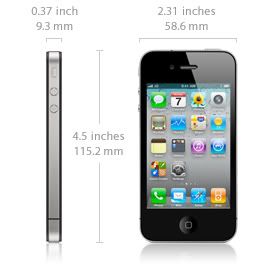
Height:     4.5 inches (115.2 mm)
Width:     2.31 inches (58.6 mm)
Depth:     0.37 inch (9.3 mm)
Weight:    4.8 ounces (137 grams)
Cellular and wireless
  • GSM model: UMTS/HSDPA/HSUPA (850, 900, 1900, 2100 MHz); GSM/EDGE (850, 900, 1800, 1900 MHz)
  • CDMA model: CDMA EV-DO Rev. A (800, 1900 MHz)
  • 802.11b/g/n Wi-Fi (802.11n 2.4GHz only) 
  • Bluetooth 2.1 + EDR wireless technology
Power and battery
  • Built-in rechargeable lithium-ion battery
  • Charging via USB to computer system or power adapter
  • Talk time:
Up to 7 hours on 3G
Up to 14 hours on 2G (GSM model only)
  • Standby time: Up to 300 hours
  • Internet use:
Up to 6 hours on 3G
Up to 10 hours on Wi-Fi
  • Video playback: Up to 10 hours
  • Audio playback: Up to 40 hours
TV and video
  • Video formats supported: H.264 video up to 720p, 30 frames per second, Main Profile level 3.1 with AAC-LC audio up to 160 Kbps, 48kHz, stereo audio in .m4v, .mp4, and .mov file formats; MPEG-4 video, up to 2.5 Mbps, 640 by 480 pixels, 30 frames per second, Simple Profile with AAC-LC audio up to 160 Kbps per channel, 48kHz, stereo audio in .m4v, .mp4, and .mov file formats; Motion JPEG (M-JPEG) up to 35 Mbps, 1280 by 720 pixels, 30 frames per second, audio in ulaw, PCM stereo audio in .avi file format
  • Support for 1024 by 768 pixels with Apple VGA Adapter; 576p and 480p with Apple Component AV Cable; 576i and 480i with Apple Composite AV Cable (cables sold separately)
Camera, photos, and video
  • Video recording, HD (720p) up to 30 frames per second with audio
  • 5-megapixel still camera
  • VGA-quality photos and video at up to 30 frames per second with the front camera
  • Tap to focus video or still images
  • LED flash
Sensors
  • Three-axis gyro
  • Accelerometer
  • Proximity sensor
  • Ambient light sensor
Headphones
  • Apple Earphones with Remote and Mic
  • Frequency response: 20Hz to 20,000Hz
  • Impedance: 32 ohms
Hardware and Styling

It is also home to a 5 megapixel camera with LED Flash. The phone itself is like an expensive piece of jewellery. The gorgeous 'Retina Display' and the home button dominate the front.  The sides are tapered with a steel band, which also doubles as the dreaded antenna, which caused the infamous iPhone death grip issue which was causing call drop outs in the US.

On the right side is the micro-sim port while on the left Apple has provided the redesigned volume buttons (previously a volume rocker) and the mute button. The top of the device is home to the 3.5mm port and the power button while the bottom houses the 30 -pin connector slot.

Interface

The iPhone is home to the simplest smartphone OS in the industry, the iOS. So simple to use is the iOS that this reviewer's eighty-year-old grandfather dumped his laptop for the iPad, which also uses the iOS.

The home screen of the iOS provides a wall full of all the applications installed on the device. There is also a Mac OSX like dock which allows four apps to be opened simultaneously and which can be customized by each user. Just swipe towards the right to reveal the other apps. Unlike other operating systems there is no menu button to reveal all the apps, the apps are just there.

This user interface works since it has no learning curve, making the iPhone a plug and play device for novices.
 
There are no widgets in iOS. This is a disadvantage as one has to no way of viewing information without entering an app - cue the Weather and Stock apps. On Android, widgets act as shortcuts and provide considerable information. Similarly, the tile interface on Windows Phone provides similar access to information.

iOS, in its current form, has a fairly bad notifications system which is very intrusive in nature. For example, with news app open in the background while playing Angry Birds, the app will flash the notification right in the middle of the screen pausing the gameplay. This happens even if the user does not want to view the notification. Fortunately, iOS 5 - which was shown off at Apple's World Wide Developers Conference in June - will have a revamped Android like notifications system along with other goodies.

The onboard keyboard is the best virtual keyboard on the market. Keys are well spaced and OS provides brilliant auto correction abilities.

Multimedia

The iPhone is the home to the world's best MP3 player, the iPod. There is simply no arguing with this statement. It is definitely a multimedia leviathan.

Like all iOS devices, this contains a movie player too. But, the biggest disadvantage of this app is its lack of support for popular video formats. One has to go through a lengthy conversion process for videos.

The 3.4-inch display boasts of a 960x640 resolution, which is currently the highest among all smartphones. It even has an astounding pixel count of 326 PPI through which it gets its Retina moniker.

Apple has upgraded the camera of the iPhone with a 5-megapixel OmniVision sensor. The images are very vibrant and the color reproduction is very impressive.

As far as 720p video recordings go, the iPhone is right on par with the Sony Ericsson Xperia Arc and the Nokia N8.

Another feature, which makes the iPhone a multimedia monster, is its 16GB and 32GB memory capacities. 16 GB should be enough for most but media gobblers would appreciate the 32GB capacity. Unfortunately, we don't get a memory card slot for expansion.

Performance

At launch, the iPhone 4 knocked the wind out of the competition with its blistering performance. This was possible because of the A4 processor, which is clocked at 1GHz and a meaty 512MB of RAM. We are told that Apple has under-clocked the A4 processor to 800 MHz, but it still scorches. Even today, in comparison to dual-core NVidia Tegra powered smartphones, the iPhone 4 feels like a screamer.

This is inherently because Apple develops its own software and hardware. The software is always in tune with the hardware, which helps Apple derive more performance from lesser hardware. The same cannot be said about the modern Android Smartphones, as all Android phones don't have a standardized hardware spec.

The call quality of the Airtel iPhone can be best described as average. We haven't really faced the now legendary 'death grip' issues but its still not the best calling experience. This could be a combination of factors involving the network and the Phone.

The iPhone surprised us with an impressive battery life which lasted a day, which include constant 3G or Wi-Fi, Web browsing and phone calls while playing multiple games. It was very impressive and easily bested the Android competition. 

Price:
Price tag starting at Rs 34,500 for the 16Gb version and a ridiculous Rs 40,500 for the 32 GB.